Learn more about deductive reasoning and its value in the workplace. Deductive reasoning is a logical process in which a conclusion is based on the concordance of multiple premises that are generally assumed to be true.
 Inductive Vs Deductive Reasoning Video Explanation
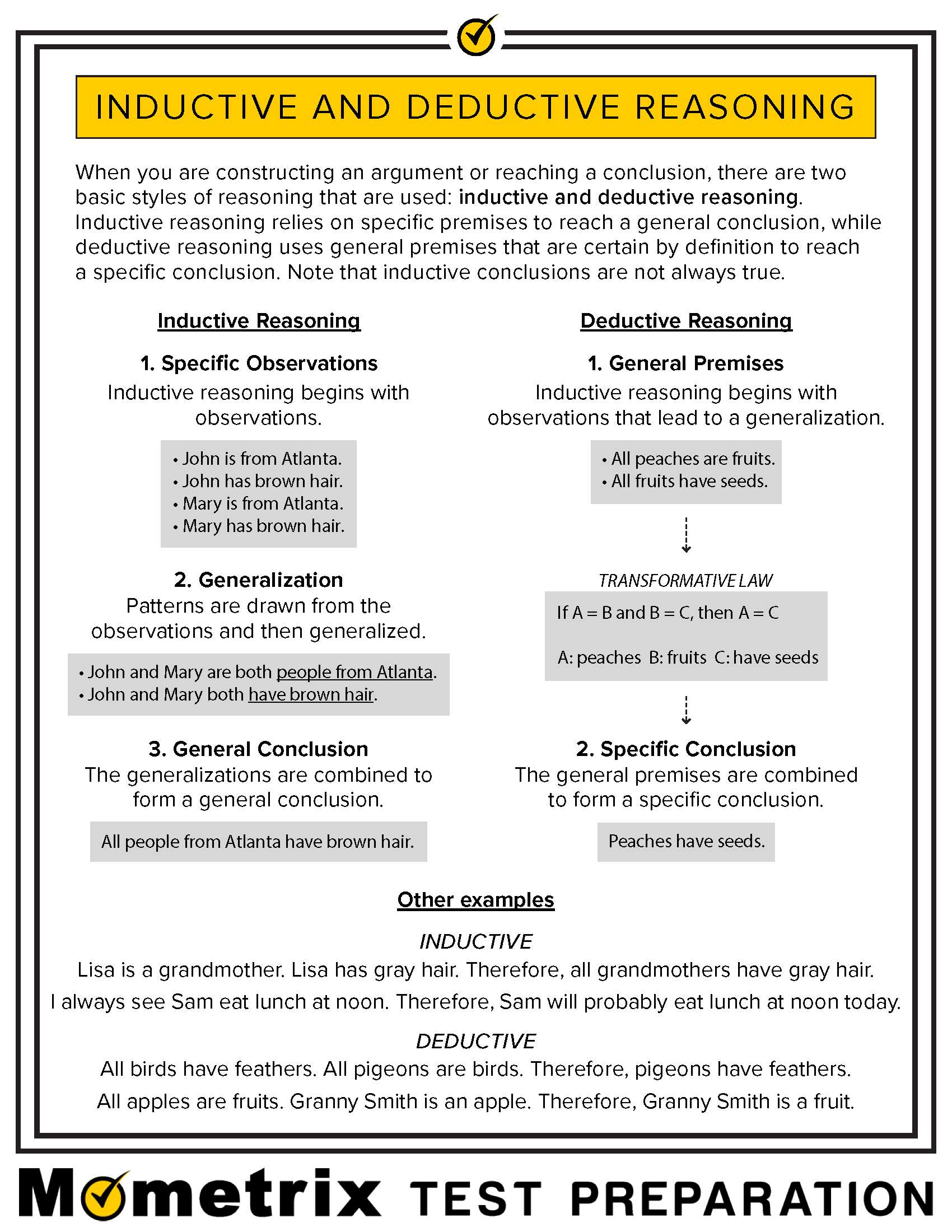
The main difference between these two types of reasoning is that inductive reasoning argues from a specific to a general base whereas deductive reasoning goes from a general to a specific instance.

Explain deductive reasoning. This assumption is usually a generalized statement. And the arguments are sound when the conclusion following those valid arguments is true. Deductive reasoning is accomplished using what is known as a syllogism.
Every syllogism has three parts a major premise a minor premise and a conclusion. For example consider the statement all apples are fruits. If the first statement is true then.
With deductive reasoning the argument moves from general principles to particular instances for example. Deductive reasoning begins with an assumption. Deductions begin with a general assumption then shrink in scope until a specific determination is made.
Deductive reasoning is a type of logical thinking that starts with a general idea and reaches a specific conclusion. Moreover deductive reasoning can be explained as reasoning from the general to the particular whereas inductive reasoning is the opposite. A second premise is made in relation to the first assumption.
A deductive argument is only valid if the premises are true. In deductive reasoning if the original assertions are true then the conclusion must also be true. In other words deductive approach involves formulation of hypotheses and their subjection to testing during the research process while inductive studies do not deal with hypotheses in any ways.
Conclusion guaranteed Deductive reasoning starts with the assertion of a general rule and proceeds from there to a guaranteed specific conclusion. Deductive reasoning is linked with the hypothesis testing approach to research. When all the proposed statements are true then the rules of deduction are applied and the result obtained is inevitably true.
Deductive Reasoning means a form of logic in which specific inferences are drawn from multiple premises general statements. Deductive reasoning or deductive logic is a type of argument used in both academia and everyday life. Also known as deduction the process involves following one or more factual statements ie.
Premises through to their logical conclusion. Deductive reasoning is the act of making a generalized statement and backing it up with specific scenarios or information. It establishes the relationship between the proposition and conclusion.
The major premise is simply a rule of general applicability or put differently a rule that applies not just to a single person or situation but rather to a category of people or situations. Deductive reasoning is one of the two basic forms of valid reasoning the other one being inductive reasoning. The process of deductive reasoning includes the following steps.
Tom Carter is aged seventy-five. Deductive reasoning moves from the general rule to the specific application. Deductive reasoning is a top-down process of understanding whether or not an assumption is true based on logic and experimentation.
Deductive reasoning gives you a certain and conclusive answer to your original question or theory. Deductive reasoning is sometimes referred to as top-down logic. People who are aged sixty or over are unlikely to be users of the Internet.
Its sometimes is referred to as top-down thinking or moving from the general to the specific. It can be thought of as a top down approach to drawing conclusions.
The differences between simple compound and complex sentences can be confusing for students. Jean rend le cartable à son frère.
 German Sentence Structure Main Sentence German Is Easy
These words have little to no meaning but they are still important to the sentence.
How to explain sentence structure. So make the style of your essay writing reflect this with more simple sentences setting out clear points followed by more complex multi-clause sentences to thoroughly explain and expand on each idea. One verb equals one sentence. When we are teaching beginners we provide them with a variety of words.
At the most basic level the English sentence structure follows a simple rule. Just as someone may be a competent cyclist and struggle to. There are two especially common sentence construction mistakes.
Once you have taught these basic. The sentences above are all examples of the SVO construct. Often especially for native English speakers much of this is done by feel.
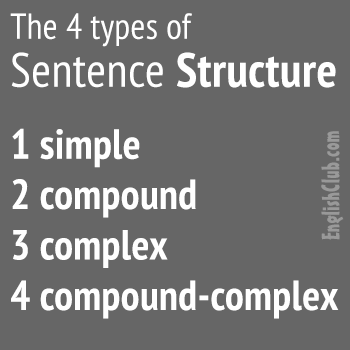
This collection of sentence structure teaching resources has been designed to assist your students in learning the nuances of how various sentences should be formed. The grammatical function or meaning of a sentence is dependent on this structural organization which is also called syntax or syntactic structure. Sentence structure determines how the different parts of a sentence are put together from its punctuation to the ordering of its words.
Remember an important part of explaining something is to give the basic idea and then go into further detail about individual points. Sentence Structure Teaching Resources. As with any topic you can teach sentence structure by teaching the basic grammar components first.
Teaching the structure of sentences is the first step towards improving students writing skills. Some of them are nouns such as things in their immediate environment and some of them are actions. In English grammar sentence structure is the arrangement of words phrases and clauses in a sentence.
A huge advantage of learning grammar in a familiar context is that learners will see how structures function in sentences and how sentences are related to each other. In teaching sentence structure it is important to emphasize to our students that though the terminology may seem quite daunting at first they will quickly come to understand how each structure works and recognize them when they come across them in a text. Marie gives the book to her teacher.
This is also called an independent clause. Subject Verb Direct Object Indirect Object. A sentence must have a complete idea that stands alone.
A sentence contains a subject that is only given once. So as your vocabulary expands you build more complex sentences adding bits of information between the subject and the verb. He obtained his degree.
First we have a subject who or what the sentence is about and then we have a verb what is that subject doingdidwill do. Begin your sentence with the subject followed by the verb and object. He subject obtained verb his degree object.
Of course like in English a sentence can also contain nouns adjectives and additional verbs. We now expand on that basic sentence structure by adding an indirect object fortowith whom is he doing it. With this in mind why not choose a well known fairy tale to explore the key components of a simple and complex sentence.
Explain that the words you added are called function words. A sentence contains a verb or a verb phrase. Teach Sentence Structure in Context.
Smith he obtained his degree. Marie donne le livre à sa maîtresse. It is important that students have a basic knowledge about parts of a sentence and their relation to each other before learning about the structure of sentences.
This structure is commonly used to build sentences in the English language and is abbreviated SVO Sentences. Note that there is only one horizontal line. Next using a different color fill in the function words The is on and a so the whole sentence reads The kid is on a box.
A sentence follows Subject Verb Object word order. These words connect important information so we can understand. Here is a sentence diagram of a simple sentence.
An independent clause is a group of words that has both a subject and a verb and expresses a complete thought. Now in English and most romance languages the word order is rigid because it serves a purpose. This video describes the basic structure of a sentence in English.
In this grammar lesson you will learn how to structure your sentences following the most common word order in EnglishJoin my complete self-study programme. A simple sentence contains only one independent clause. As well as following basic word order rules there are many other things you have to consider to write correctly and clearly structured sentences.
It is up to the individuals conducting the study to assess and understand the statistical relationship between them without having extraneous influences occur. A simple way to research the relationship between variables is through surveys and questionnaires.
 Correlation Research Design
Correlation research is both popular and useful in many scientific studies particularly in the health and social sciences.

Explain correlational research. When two variables are correlated it simply means that. As the name implies the researcher looks to establish relationships between two variables. 81 An Overview of Survey Designs A nonexperimental research design used to describe an individual or a group by having participants complete a survey or questionnaire is called the survey research design.
Based on the number of variables. The survey research design. With a positive correlation individuals who score above or below the average mean on one measure tend to score similarly above or below the average on the other measure.
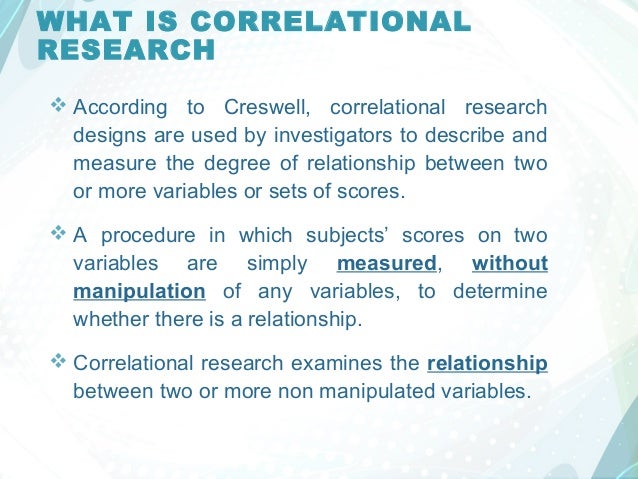
Correlational research is a type of non-experimental research in which the researcher measures two variables and assesses the statistical relationship ie the correlation between them with little or no effort to control extraneous variables. How to do correlational research Surveys. Correlation research asks the question.
Interpret the strength and direction of different correlation coefficients. 3 Correlational research is a preliminary way to gather information about a topic. Its like when a child hears the music playing from an ice cream truck.
Correlational studies are a type of research often used in psychology as well as other fields like medicine. A correlational research study uses the non-experimental method where the measurement of two variables occurs. If a relationship of sufficient magnitude exists between two variables it becomes possible to predict a score.
He makes a premise that two variables may be related in some way and then measure the value of both under different circumstances to test his hypothesis if indeed there is a relation between the two variables. Correlational research investigates the relationship between two variables and how they interact with one another. A correlation has direction and can be either positive or negative note exceptions listed later.
Correlational Research Correlation means that there is a relationship between two or more variables such as ice cream consumption and crime but this relationship does not necessarily imply cause and effect. However just because a. Explain why a researcher might choose to conduct correlational research rather than experimental research or another type of non-experimental research.
Two variables may be associated without having a causal relationship. The whole purpose of using correlations in research is to figure out which variables are. Explain why correlation does not imply causation.
Define correlational research and give several examples. What Is Correlational Research. Here researchers do not intervene and change behavior as they do in experiments.
As with most kinds of research though there are both pros and cons to correlation studies. In correlational research the goal is to identify. Correlation does not necessarily imply causation as you know if you read scientific research.
Relationship between income and age. A correlation is simply defined as a relationship between two variables. What is Correlational Research.
Correlational research is a type of non-experimental research method in which a researcher measures two variables understands and assesses the statistical relationship between them with no influence from any extraneous variable. The method is also useful if researchers are unable to perform an experiment. Correlational Research When scientists passively observe and measure phenomena it is called correlational research.
We begin this chapter with an introduction to the research design that was illustrated here. This is a type of field research where you gather data about a. Purpose of Correlational Research Correlational studies are carried out to explain important human behavior or to predict likely outcomes identify relationships among variables.
Our minds can do some brilliant things. In correlational research design a researcher measures the association between two or more variables or sets of scoresA researcher doesnt have control over the variables.